|
Need help choosing a kit?
Go
back to the "Top" of this
page
I am often
asked the question; "What tools do I need"?
The simplest way to answer this question is to group the
tools into the essential categories and break them down
into what your personal needs are and how much you want
to spend.
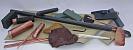
You will at least
need one of each tool type of the four groups. The tools
can be broken down into these four categories:
*You'll need something abrasive
to grind the edge of the flint with to prepare the platform
to be struck.
*Your going to need something to hit the rock with,
it's we knappers call a billet.
*A tool will be needed to do detailed pressure
flaking for, creating platforms, finished edge work
and notching.
*Finally, a hand pad will
be needed to protect yourself while using an Ishi
stick or pressure flaker.
Books and Videos:
I want to emphasize teaching media
before we get into the tools. The cost of a book and a
dvd will
quickly pay for itself in flint, time and discouragement.
Having a video means having an expert knapper at your
service any time of the day or night. DVD's won't wear
out and the knapper in the video will never complain when
you make him do the same hit 30 times in a row. The book
will help you understand the terms, angles and so much
more. These 2 things are foundational! Our goal here is
to help you learn, advance and enjoy
knapping. I still have the memory fresh in my mind of
how I struggled because I did not have good tools or knowledge.
Things are different now! The "Cat is out of the
bag!"
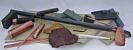
Almost all
the tools for flintknapping fall into these groups. Abrasives,
Billets, Pressure flakers, pads and protective
equipment. All the kits have these basic tools. Now,
let's take a look at each group of tools and explain them
a bit.
Abrasives:
As the process of knapping moves forward towards a finished
piece, the edge gets thinner and more delicate. The coarseness
of the abrasive should be diminished accordingly. For
roughing out preforms, a coarse 30 grit is used. For finishing
a medium 60 grit is used. Lastly, for special detail,
a 120 grit fine abrader can become quite useful. Our abraders
have just the right "bond" to retain fresh sharp
grit as they are used. Consistency is then achieved, producing
predictable results throughout the thinning process.
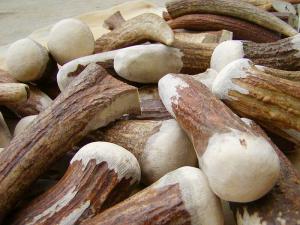
Billets:
There can be a lot to be said for this tool. There are
5 major billet types available. Billet types will be discussed
in this article on the billets
page. We are going to focus on size. In the kits are
many different sizes, The bigger the kit, the more sizes.
Why? Flintknapping starts at the quarry where (in some
cases) a large rock is broken into "spalls"
(see knapping "terms"
article). Depending on the size of the spalls, some can
be several pounds, large heavier billets are needed to
thin them. Using a billet that is too small for the job
will dent or damage it. So, the simple answer is: "the
bigger the rock, the bigger the billet". The bigger
kits have a broader spectrum of sizes.
Pressure Flakers:
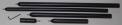
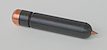
These are used to press off flakes by hand. Ishi
Sticks vs the smaller "Notchers" It's all
about personal preference. Most knappers use the longer
Ishi Sticks over the shorter pressure flakers. Here is
some thoughts to guide you along in your choice. All of
our pressure flakers feature an adjustable copper nail
tip. They are double set screwed for added peace of mind
and durability. The nail is (part
#N109; aka 20d nail) that can be easily extended as
needed. The flaker tools ("Ishi" or the "notcher")
will be the tool you use for your notching, edge work
and most important, for platform
building. It will give you the accuracy you need to
create good quality striking platforms --the heart of
good knapping techniques. The difference between the notcher
and the 20" long Ishi stick is the power and control
that can be generated with the longer Ishi stick. The
flex in the 3/4 dia. Ishi gives an added "spring"
affect, helping to transfer the energy through the flake
detachment process resulting in longer, cleaner flakes.
All our 20" Ishi sticks have the Allen Key tool built
right into the handle
for convenience and storage. A great new feature! Read
more about ishi sticks here.
Pads:
There are hand pads and leg pads. The hand
pads are to protect your hands during the pressure
flaking process only. There are many types available.
I prefer the simple leather hand pad. The better more
advanced artists prefer the grooved
rubber pads. Fancy flake-over-grinders almost all
use a notched or grooved pad. There is an advantage to
the grooved pads because they allow the flake to detach
in "open air". For some reason, this helps keep
the flake from creating small finger nail type step fractures.
Leg pads are needed to save your pants and leg from cuts
and can help to limit bruising if your doing heavy work.
I almost always have my leg pad in the active position
while knapping. Some knappers do all their percussion
work on the leg pad. I tend to hold the preform up in
my hand suspended and take swings at it there. Once again,
personal preference. Safety
glasses, gloves and other items are a must for the expert
and novice knapper.
In
summary, there are many variations of tools and they all
work. It's just a matter of finding the one that works
best for you. The kits are a compilation of tools that
have been most popular to the majority of knappers. Experiment,
remember cause and effect, have fun, stay out of trouble,
be careful, feed the dog, grind before you strike, buy
a box of Band-Aids, remain calm, stop reading this and
go chip one!
Go back to the "Top" of this
page
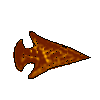
Florida "Hillsboro" type chipped from Agatized
Coral.
Point by: Mark Bracken
|